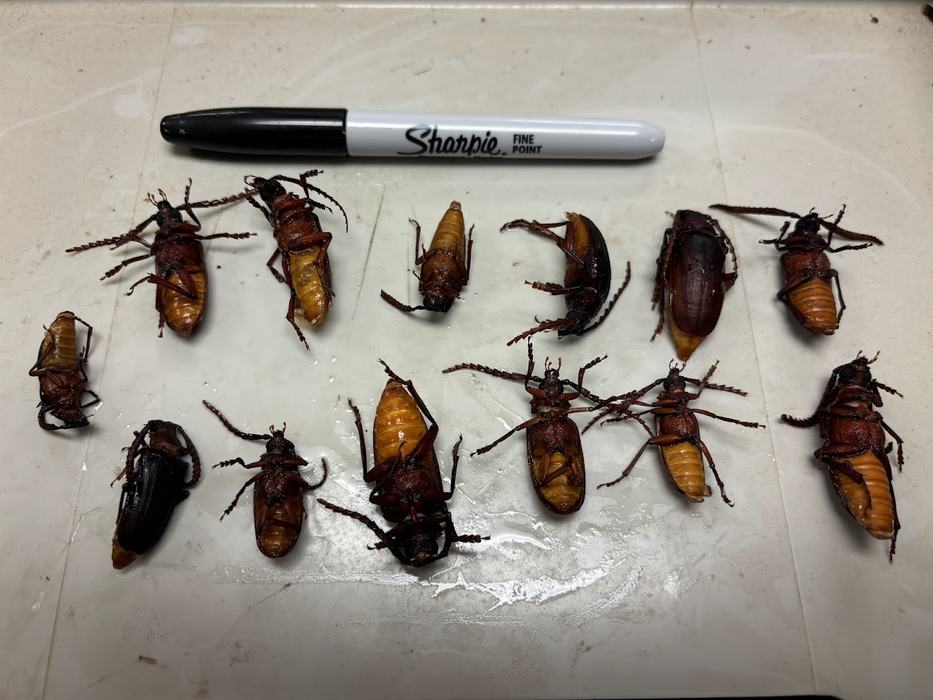
The NCSU Extension’s Department of Entomology and several Extension Agents in Southeastern NC are working to monitor and find controls for an emerging pest in blueberries. The Prionus beetle is actually a native insect that hasn’t been seen as a pest in blueberries until a short time ago. Currently there are several farms in the area that have infestations of Prionus beetles and thousands have been collected from the traps.
The life cycle of Prionus beetles includes larvae that feed inside the roots and base of the stems for 3-5 years (estimation based on Prionus in other hosts). This is when they cause the most damage to a Blueberry plant. Then, the larvae exit the roots, create an oval cocoon in the soil, and emerge as adults after 4-8 weeks. The adults do not feed, so they mate immediately after emerging in summer and die after 4-8 weeks when they use all their stored energy. During that time, traditionally, females lay eggs at the base of the plant in the soil, and the larvae emerge about 3-4 weeks after.
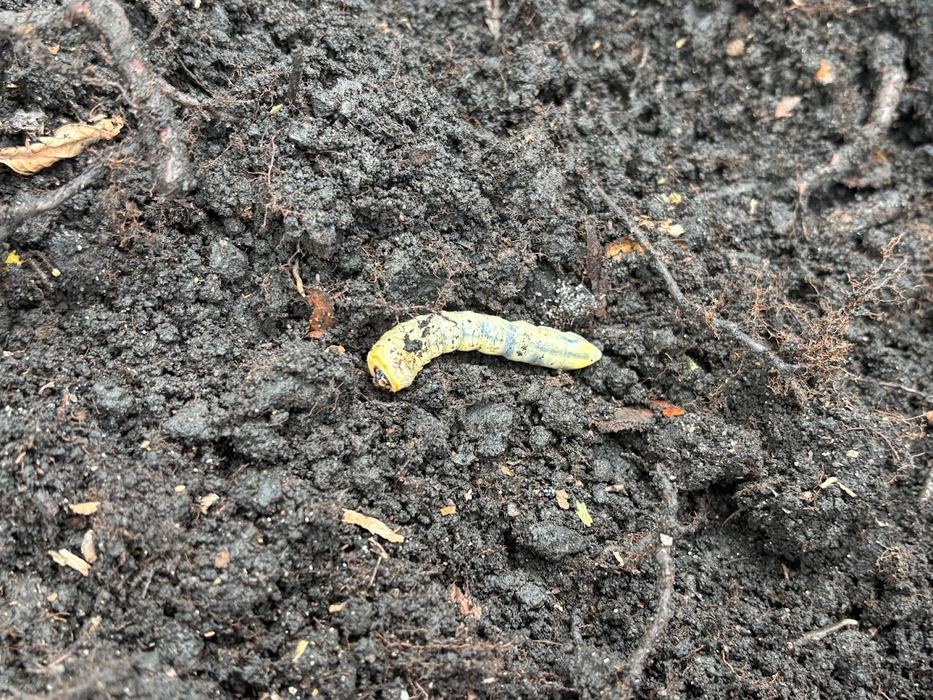
Researchers have also observed small beetle larvae on canes up to 4 ft. high. This makes sampling and scouting for the pest a little more challenging, especially when there aren’t any direct observations that can be made that clearly show infestation. Damage is not immediately observed and is generally not observed until plant health is on the decline, and most of the time the plant cannot recover, since there are no current methods of control against this pest. What can be seen is a plant or plants that are defoliating with some dead or dying canes within a plant. This is also a symptom that can be characterized by a range of different factors, including drought, disease, and old age of the plants. Damage can be in patches of plants that seem to grow larger or individual plants with a degree of randomness. This pest does not pose a threat to damaging the fruit or to human health.
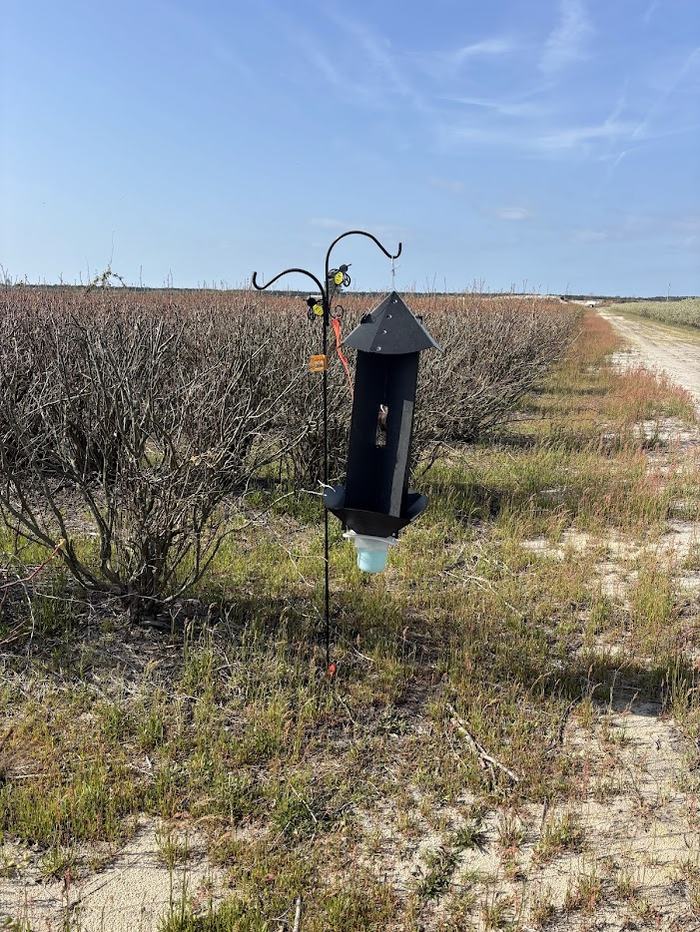
To sample to see if you have larvae in your fields, you can dig up suspect plants and see if you have holes, frass (waste produced by the larvae), or the larvae in the stumps or soil surrounding the plants’ roots. We have been using panel traps with pheromone lures to trap adult males. If you wish to use traps, please note that even though you may trap the adult males it may not constitute an infestation. Only finding larvae feeding directly on blueberry roots is confirmation of infestation. These are native beetles that have other hardwood host species in the surrounding areas and are strong flyers and are able to travel long distances.
Currently, there are no chemical insecticides labeled for this pest and NCSU researchers and County Agents are participating in a working group with IR-4 project, which is housed at NCSU to evaluate prospective control with products already on the market and to get those that are effective labeled for use to manage Prionus beetles.
Sources for the traps and lure are Alpha Scents, Evergreen, and Great Lakes IPM.
For questions about Prionus beetle monitoring email matthew_strickland@ncsu.edu or call Matthew Strickland at 910-862-4591.